
20+ years of production experience
Leave Your Message

China Best Foam Yoga Mat Manufacturer and Supplier

Choosing a Foam Yoga Mat requires more than comparing color, thickness, and price. The right mat supports steady movement, confident balance, and comfortable daily practice. It should feel secure beneath bare feet, especially during lunges, planks, and seated stretches.

B.K.S. Iyengar, one of yoga’s most influential teachers, said, “Yoga does not just change the way we see things, it transforms the person who sees.” His words remind buyers that equipment should serve practice, not distract from it. A reliable Foam Yoga Mat needs practical performance. It should offer suitable cushioning, stable grip, easy cleaning, and consistent recovery after repeated use.

As an experienced manufacturer and supplier, we focus on measurable details. Our production process examines foam density, surface texture, edge finishing, odor control, and dimensional stability. Samples are checked before bulk production. We also support private labeling, custom sizes, color development, and packaging solutions for retailers and fitness brands.

Small details matter. A soft surface may feel comfortable at first, yet excessive softness can reduce balance. A textured finish can improve traction, but it may collect dust more easily. We continue refining this balance through customer feedback and product testing. Not every design is perfect from the beginning. That honest limitation encourages better improvement.

From material selection to final inspection, our goal is dependable quality. This guide explores how to identify a suitable Foam Yoga Mat and choose a trustworthy China-based manufacturing partner. A better mat cannot replace consistent practice, but it can make every session feel more supported.

China Best Foam Yoga Mat Manufacturer and Supplier

Overview of China’s Foam Yoga Mat Manufacturing Industry

China’s foam yoga mat manufacturing industry combines material processing, mold development, printing, and export logistics. Many factories work with EVA, NBR, or other foam blends. Each material changes cushioning, grip, weight, and recovery speed. Production usually begins with foam mixing and sheet formation. Manufacturers then control thickness, surface texture, cutting accuracy, and edge finishing.

From factory evaluations, consistency matters more than a low first quotation. Buyers should review density records, compression tests, odor checks, and sample measurements. A mat may feel soft during inspection but flatten after repeated use. That weakness is easy to miss. Reliable suppliers normally keep batch records and inspect products before packing. However, quality systems still vary between facilities. A careful buyer should verify claims through independent testing when practical.

Tips: Request samples from different production batches. Measure thickness after 24 hours. Test the mat on wood, tile, and carpet. Check whether the surface becomes slippery with light moisture. Ask for packaging details, because tight rolling can affect foam recovery. Clear specifications reduce misunderstandings about color, size, texture, and tolerances. It is also wise to discuss recyclable packaging and realistic production schedules. A rushed order may expose problems that a sample never showed.
Key Materials and Construction Standards for Foam Yoga Mats

China Best Foam Yoga Mat Manufacturer and Supplier

Key Materials and Construction Standards for Foam Yoga Mats

Material choice controls grip, comfort, odor, and service life. TPE foam feels light and flexible, while NBR foam offers stronger cushioning for knees and wrists. EVA foam can provide firm support, but it may feel less stable during heated practice. A 6–8 mm thickness usually balances comfort and portability. Thicker is not always safer.

A reliable production specification should define foam density, hardness, thickness tolerance, rebound, and compression set. ASTM D3574 and ISO 3386 provide useful references for testing cellular foam properties, although they are not universal yoga mat laws. Closed-cell construction helps reduce water absorption and simplifies surface cleaning. A textured top layer should remain bonded after repeated bending. Edges need clean trimming, without exposed foam or peeling films.

The OECD Global Plastics Outlook reported that only 9% of global plastic waste was recycled in 2019. This matters because mixed foam layers can be difficult to separate after use. Manufacturers should therefore record material composition and avoid unnecessary laminations. A practical quality check includes odor testing, dimensional measurement, repeated roll testing, and wet-slip observation. One weakness remains: laboratory results may not match a sweaty studio floor. Field trials still deserve more attention.

China Best Foam Yoga Mat Manufacturer and Supplier - Key Materials and Construction Standards for Foam Yoga Mats

Material / Construction Typical Composition Typical Density Range Common Thickness Key Performance Features Recommended Quality Checks
NBR Foam Nitrile-butadiene rubber foam, commonly produced as a closed-cell material Approximately 60–120 kg/m³, depending on formulation and foaming ratio 6–15 mm Soft cushioning, good moisture resistance, easy cleaning and suitable for fitness applications Density, compression set, tensile strength, elongation, odor and dimensional stability
TPE Foam Thermoplastic elastomer foam, often formulated for recyclability and low odor Approximately 50–100 kg/m³ 4–10 mm Lightweight, resilient, low-odor potential and suitable for textured surfaces Slip resistance, rebound, compression recovery, surface bonding and chemical screening
PVC Foam Flexible polyvinyl chloride foam with plasticizer and stabilizer system Approximately 80–180 kg/m³ 4–10 mm Cost-effective, flexible, printable and available in a wide range of surface textures Plasticizer migration, heavy metals, tensile properties, odor, surface wear and dimensional tolerance
EVA Foam Ethylene-vinyl acetate copolymer foam, generally manufactured with a closed-cell structure Approximately 50–150 kg/m³ 6–20 mm Lightweight, shock-absorbing and economical; suitable for thicker exercise mats Compression set, tear resistance, cell uniformity, thickness recovery and odor
Natural Rubber Foam Natural rubber latex or solid rubber compound, sometimes laminated with a fabric or surface layer Approximately 100–250 kg/m³ 3–6 mm High elasticity and strong grip potential; may have a noticeable natural-rubber odor Latex allergen declaration, tensile strength, tear strength, aging, odor and surface traction

Recommended Construction and Compliance Specifications

Quality Dimension Recommended Requirement Why It Matters Common Reference or Test Basis
Thickness Control Nominal thickness selected according to use; typical tolerance should be agreed in the purchase specification, commonly around ±0.3–0.5 mm for standard foam mats Ensures consistent cushioning, balance and packaging dimensions Calibrated thickness gauge and approved sample reference
Dimensional Stability Length, width and flatness tolerances should be defined before production; the mat should remain flat after conditioning and roll storage Reduces curling, shrinkage and fit problems during use Conditioning test, visual flatness inspection and dimensional measurement
Cell Structure Uniform, primarily closed-cell foam with no visible voids, cracks, delamination or uneven foaming Improves moisture resistance, durability and surface consistency Cross-section inspection, water-absorption evaluation and visual inspection
Density Uniformity Density should be consistent across the mat and within the agreed product specification Supports predictable cushioning, weight and compression performance ISO 845 or another agreed cellular-plastics density method
Compression Recovery The foam should recover its thickness after repeated loading, with the acceptance limit established for the intended product category Helps prevent permanent dents and loss of cushioning Compression-set or repeated-compression test agreed between buyer and manufacturer
Surface Grip Top and bottom textures should provide stable contact on the intended floor under dry conditions; wet-grip performance should be tested separately Reduces sliding during standing poses and floor exercises Buyer-approved friction test protocol using representative footwear, skin or flooring
Tensile and Tear Strength Values should be matched to the material, thickness and intended frequency of use Improves resistance to stretching, edge tearing and repeated rolling ISO 1798, ISO 37 or ASTM D412 where applicable to the selected material
Odor and Emissions No unacceptable odor after production and adequate ventilation; restricted substances should comply with the destination market Supports user comfort and regulatory acceptance Sensory odor assessment and destination-market chemical testing
Chemical Compliance Screen for restricted substances relevant to the material and sales region; retain supplier declarations and laboratory reports Helps meet import, retail and product-safety requirements EU REACH Regulation (EC) No 1907/2006; U.S. requirements such as CPSIA may apply depending on product positioning
Surface Finish and Printing Texture should be uniform; printed graphics should resist rubbing, sweat and routine cleaning Preserves appearance and reduces transfer or premature fading Abrasion, color-transfer, adhesion and cleaning-resistance tests

Note: Material performance ranges are typical industry reference values rather than universal requirements. Final specifications should be confirmed through approved samples, production tolerances and destination-market testing.

How to Evaluate a Reliable Chinese Foam Yoga Mat Supplier

A reliable Chinese foam yoga mat supplier should provide more than attractive product photos. Ask for the factory address, production capacity, and recent quality records. A video call can reveal storage conditions, cutting equipment, and packaging areas. Clean floors and organized material racks matter.

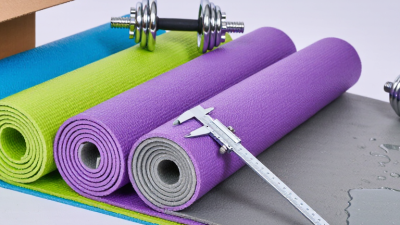
Request samples from the same production line, not only a showroom sample. Check thickness at several points with a caliper. Measure length, width, surface grip, rebound, and foam density.

Smell the mat after opening the sealed package. A strong chemical odor deserves further testing. Ask for reports covering material safety, color stability, and restricted substances. Verify the laboratory and report date independently.

Production consistency is often the real test. Order a small trial batch and compare ten mats from different cartons. Look for curled edges, uneven texture, printing shifts, and weak straps. Clarify acceptable defect limits in writing. Confirm lead time, carton dimensions, replacement terms, and inspection responsibility before payment.

I once focused too much on unit price. That was a mistake. Low-cost foam may compress quickly or vary between batches. A dependable supplier welcomes factory audits, explains limitations, and shares corrective action records when something goes wrong. Their answers should be specific, not merely “good quality.”

Production, Quality Control, and Customization Capabilities

A reliable foam yoga mat manufacturer needs more than high-volume equipment. It needs practical production experience. In China, experienced factories select foam density, thickness, and surface texture according to different training needs. Closed-cell foam can resist moisture, while textured surfaces improve grip during balance poses. Production teams monitor mixing, foaming, cutting, and edge trimming at every stage. Small details matter.

Quality control begins with incoming material checks. Technicians measure density, thickness, dimensions, and surface uniformity. They also inspect odor, color consistency, flexibility, and recovery after compression. A sample may be rolled repeatedly, then placed flat to check whether it returns to its original shape. Batch records help trace problems to specific materials, machines, or shifts. These records support honest communication with buyers.

Customization can include size, color, logo placement, packaging, carry straps, and surface patterns. Technical staff should confirm artwork, tolerances, carton dimensions, and packing methods before mass production. Pre-production samples reduce costly misunderstandings. However, no production line is flawless. Foam may show slight variation between batches, especially when temperature changes. A responsible supplier admits this risk and sets realistic tolerances. Clear inspection standards, photos, and approval samples make cooperation more dependable.

China Foam Yoga Mat Manufacturing: Production, Quality Control & Customization

This illustrative, non-brand QC benchmark shows common production checkpoints used for foam yoga mats. Custom specifications can be adjusted through material selection, thickness control, surface finishing, packaging, and private-label requirements.

Export Services and Factors for Selecting the Best Manufacturer

China Best Foam Yoga Mat Manufacturer and Supplier

Export Services and Factors for Selecting the Best Manufacturer

Selecting a foam yoga mat manufacturer requires more than comparing unit prices. Check foam density, surface grip, thickness tolerance, and edge finishing. These details affect comfort, durability, and customer returns. Request samples from the same production line used for bulk orders. A sample may look excellent, while mass production exposes uneven cutting or weak lamination.

Reliable export service should cover clear quotations, commercial invoices, packing lists, and shipment coordination. Ask whether the supplier can provide carton dimensions, loading plans, and realistic lead times. These details help control freight costs and prevent warehouse surprises. Confirm packaging protection, especially for humid routes and long ocean transport. Product labels should match the destination market’s requirements. Independent inspections can verify dimensions, color consistency, odor, and packaging before shipment.

Communication matters greatly. Choose a factory that answers technical questions with measured evidence, not vague promises. Review production capacity, material traceability, quality procedures, and experience with similar export orders. A lower price is not always economical. It may reflect thinner foam, unstable raw materials, or limited after-sales support. No supplier is perfect. Even a well-managed factory can face delays during peak seasons. Build a written agreement covering tolerances, replacements, payment milestones, and inspection rights. Leave room for review. Your first order should test the supplier’s process, not merely fill a container.