Top Abc Foam Mat Manufacturers and Suppliers
Choosing the right Abc Foam Mat manufacturer requires more than comparing prices or browsing polished product photographs. This guide examines suppliers through practical evidence: foam density, thickness consistency, surface texture, edge alignment, odor, packaging, and documented quality controls. A reliable mat should feel stable underfoot, resist tearing at the corners, and remain connected when children or athletes move across its surface. Samples matter. So do factory records.
Quality expert W. Edwards Deming offered a useful warning: “Quality comes not from inspection, but from the improvement of the production process.” His principle applies directly to Abc Foam Mat production. Strong suppliers build quality into material selection, mold control, curing, cutting, and final inspection. Buyers should request technical data, safety test reports, cleaning guidance, and clear warranty terms. Vague claims deserve careful questions.
This overview compares leading manufacturers and suppliers by experience, technical capability, product range, customization, delivery reliability, and customer support. It also considers real installation details, such as uneven floors, damp storage rooms, strong sunlight, and frequent disinfecting. These conditions can expose weaknesses quickly. A low price may look attractive, but replacement costs can quietly exceed the original budget.
No supplier is perfect. Even a reputable factory may have inconsistent batches or slow communication. That is why thoughtful buyers should test samples, verify documents, and discuss expected use before ordering. The strongest choice is not always the largest company. It is the supplier that offers dependable evidence, practical advice, and a product suited to the space.
ABC Foam Mat Types: EVA and PE Densities from 30–250 kg/m³
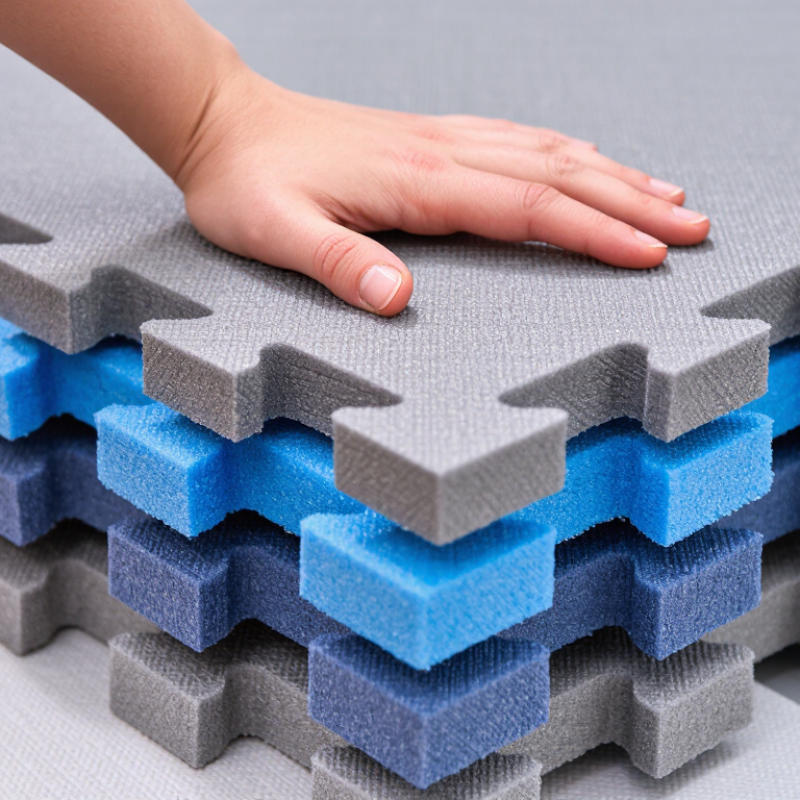
ABC foam mats depend heavily on material density. EVA and PE are common choices. Their densities typically range from 30 to 250 kg/m³. That range is not decorative. It changes cushioning, recovery, weight, and compression resistance.
A 30–60 kg/m³ EVA mat feels soft under bare feet. It suits play areas, light exercise, and temporary floor protection. Medium-density EVA, around 70–120 kg/m³, offers better shape retention for gyms and workshop flooring. Higher-density EVA, from 150–250 kg/m³, supports heavier loads but may feel firmer. PE foam often provides stronger moisture resistance and impact protection. It can work well in packaging-related interiors, protective liners, and industrial floor systems. Grand View Research reported that the global EVA market reached approximately USD 11.2 billion in 2023. Its analysis also projects steady growth through 2030, supported by construction, footwear, and protective applications.
MarketsandMarkets identifies lightweight polymer foams as important materials for impact control and insulation. However, density alone cannot prove quality. A tidy density chart can mislead. Buyers should request density tolerance, compression set, hardness, thickness recovery, and water absorption data. ISO 845 and ASTM foam-testing methods can support more reliable comparisons.
In practical evaluations, two mats with identical density may perform differently after repeated compression. Cell structure, molding pressure, and additives matter. Suppliers should provide batch test records, not only attractive product sheets. This part is often overlooked.
Safety Standards: ASTM F1292, EN 71, CPSIA, and Slip Resistance
Top Abc Foam Mat Manufacturers and Suppliers
Safety testing should guide every foam mat purchase, not decorate a supplier’s webpage.
ASTM F1292 measures impact attenuation for playground surfacing, including critical fall height and head-injury criteria. It does not automatically prove safe edges, cleanability, or slip resistance. That distinction matters. A mat may soften a fall yet slide across a polished floor.
EN 71 supports toy safety in European markets. EN 71-1 addresses mechanical and physical properties, while EN 71-3 evaluates migration of certain elements. In the United States, CPSIA requirements cover lead, phthalates, testing, and product tracking information. Suppliers should provide current laboratory reports, test methods, sample identification, and production-lot traceability. Generic certificates deserve questions. They can describe another material or an outdated batch.
Slip resistance needs separate evidence.
Ask for the tested surface condition, footwear type, wet or dry method, and measured coefficient of friction. WHO reports approximately 684,000 fatal falls worldwide each year, with adults over 60 facing the greatest risk. Foam mats cannot solve every fall hazard. The European Commission’s 2023 Safety Gate report recorded 3,412 product alerts, with chemical risks representing 32%. That figure reinforces a practical lesson: inspect odor, surface wear, interlocking gaps, and cleaning damage, not only paperwork. Suppliers should explain limitations honestly. Tests are snapshots, not magic shields.
Manufacturer Evaluation: ISO 9001, MOQ, Lead Time, and Production Capacity
When evaluating foam mat manufacturers and suppliers, ISO 9001 should be checked beyond the certificate on a website. Ask for the certificate number, scope, issuing body, and recent audit status. A reliable factory can show batch records, calibration logs, and corrective-action reports. Request samples from current production, not only polished sales samples. Check thickness, density, surface grip, odor, edge cutting, and compression recovery. Small differences become obvious after repeated folding and daily use.
MOQ affects more than purchase volume. It may determine tooling, color mixing, packaging, and production scheduling. Ask whether the quoted MOQ applies per design, color, size, or total order. A low MOQ can support market testing, but unit costs may rise sharply. Get written pricing for sample, trial, and repeat orders. I have seen buyers compare only carton prices and miss mold fees. That mistake is expensive.
Lead time should be divided into sampling, approval, material preparation, production, inspection, and shipment. Request realistic dates and a written response plan for delays. Production capacity needs evidence, such as monthly output, active lines, shift patterns, and peak-season utilization. Promises need evidence. Capacity figures may not reflect your product or packaging needs. Ask for recent order examples without confidential details. A factory may promise too much. Leave room for inspection and rework, because quality plans rarely survive unchanged.
Top Abc Foam Mat Manufacturers and Suppliers - Manufacturer Evaluation: ISO 9001, MOQ, Lead Time, and Production Capacity
Quality Checks: Compression Set, Tensile Strength, Odor, and Test Reports
When comparing foam mat manufacturers and suppliers, compression set deserves close attention.
ASTM D3574 Test D commonly measures recovery after 22 hours at 70°C and 50% compression. A lower result usually indicates better resilience. However, one number cannot describe every use. A children’s play mat, gym tile, and packaging insert face different loads.
Tensile strength and elongation should appear together in the report.
ISO 1798 specifies controlled test shapes, pulling speed, and measurement conditions for flexible cellular materials. Ask suppliers for specimen thickness, production batch, conditioning temperature, and failure location.
A mat may show strong tensile results but still tear at a sharp edge. That detail matters.
Test samples should represent actual production, not only a carefully selected laboratory sheet.
Odor evaluation needs equal discipline.
VDA 270 uses a graded sensory scale, commonly from 1, “not perceptible,” to 6, “unbearable.” ASTM D3574 also includes odor assessment for flexible foams, but laboratories may use different conditioning procedures.
Confirm the test temperature, aging time, panel size, and scoring method.
Reports should include date, laboratory qualification, equipment, raw values, and pass criteria. A polished certificate can still hide weak traceability.
I have seen specifications accepted without batch identification; that is a preventable mistake. Request samples from at least two lots, then compare compression recovery, tensile failure, odor ratings, and report consistency before approving a supplier.