7 Best Workout Floor Mats for Home Gyms in 2026
A home gym can begin with a pair of dumbbells, a bench, and a narrow strip of floor that suddenly takes every landing. The surface matters. It affects grip, comfort, noise, and how confidently you move through a workout. The American College of Sports Medicine’s 2025 Worldwide Survey of Fitness Trends lists traditional strength training among the leading trends identified by fitness professionals. The Global Wellness Institute’s 2024 Global Wellness Economy Monitor valued the physical activity sector at about $1.06 trillion in 2023. That figure covers far more than home equipment, but it shows the scale of interest in staying active. It does not prove that any particular mat is worth buying.
This guide to the 7 Best Workout Floor Mats for Home Gyms in 2026 compares options for strength training, bodyweight circuits, and everyday floor exercises. We look at practical details: thickness, traction, material, cleaning, edge stability, and fit beneath common equipment. A mat that cushions yoga may compress under a bench. A thick tile may protect flooring but feel awkward during lunges. Small differences matter. Testing conditions and available product information can vary, so rankings should be treated as a useful starting point, not a universal verdict. No mat fixes a slippery floor, poor setup, or unsuitable equipment. Still, the right one can make a home workout feel steadier—and spare your knees and floor some unnecessary punishment.
What Workout Floor Mats Are and How They Protect Home Gym Floors
A workout floor mat is a protective, resilient layer placed between exercise equipment or movement zones and the floor. Depending on its material and construction, it can soften impact, improve grip, and help limit scratches, scuffs, and sweat reaching the surface below. Under a bench or weights, a dense mat can also spread pressure across a wider area. It cannot prevent every dent, though. Heavy loads and grit trapped underneath may still damage flooring.
The details matter. ASTM F2772 evaluates indoor sports-floor systems for properties such as shock absorption and vertical deformation; it is a useful technical reference, not proof that every home mat has been tested. Check whether a mat lies flat, resists sliding, and fits the equipment footprint. Leave room around its edges. Small gaps can catch toes or collect dust. CDC’s 2020 Behavioral Risk Factor Surveillance System analysis found that about one in four U.S. adults met both aerobic and muscle-strengthening activity guidelines. More people exercising at home makes floor protection practical, but a mat is not a cure-all. Air out damp mats and inspect the floor beneath them regularly.
Workout Floor Mat Thickness: Common Sizes
The chart compares common nominal thickness sizes, with millimeter values converted directly from inches. Thicker mats can provide more cushioning, but thickness alone does not determine floor protection; material, flooring type, equipment weight, and load distribution also matter.
How Workout Floor Mats Are Evaluated for Home Gyms
We evaluate workout floor mats by how they behave during real home exercises, not by thickness alone. The American College of Sports Medicine’s 2024 Worldwide Fitness Trends survey ranked strength training with free weights third, underscoring why stable footing matters for common home workouts. We check grip on hard floors and low-pile carpet, then test whether a mat shifts during lunges or compresses unevenly beneath a dumbbell. Small details count: curled corners can catch a toe, while open seams collect dust and sweat. That matters.
We also consider cushioning, recovery after repeated pressure, cleaning, odor, and noise on shared floors. ASTM F2772 describes performance measures for indoor sports-floor systems, including shock absorption and vertical deformation; these are useful reference points, not a home-mat certification. Our comparisons use consistent hands-on checks, but they cannot reproduce years of daily use or every floor type. A mat that feels secure under bodyweight may still slide under a bench. We record those trade-offs rather than treating one feature as decisive, and note when product claims lack clear test details.
The 7 Best Workout Floor Mats for Home Gyms in 2026
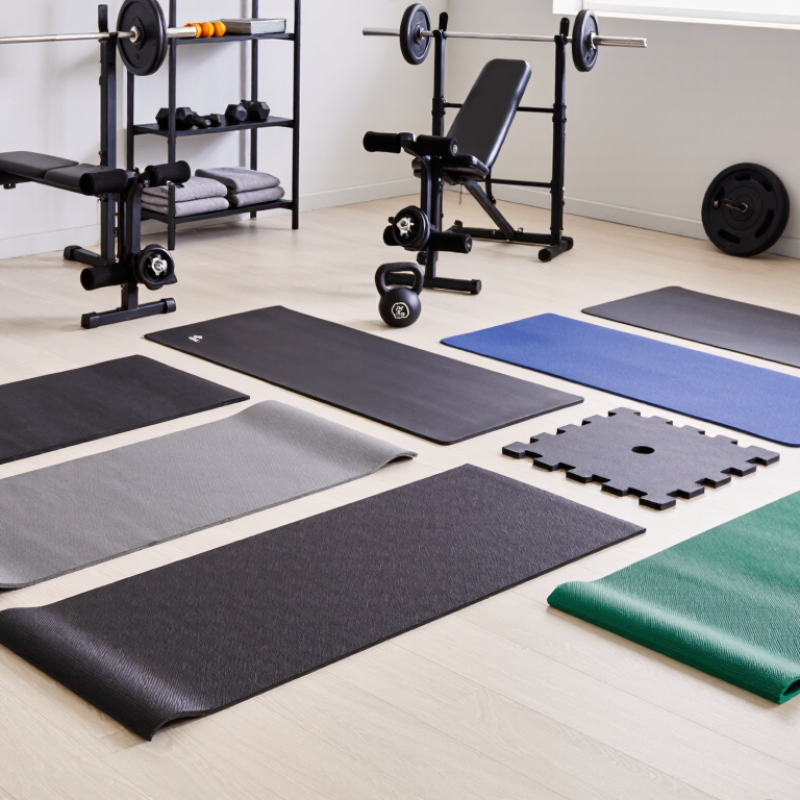
The best workout floor mats for home gyms in 2026 depend on your training, floor, and available space. A thick foam mat cushions bodyweight exercises, but heavy weights can leave dents. Dense rubber handles dumbbell work better and helps reduce noise, though it can feel firm during floor stretches. For a small room, a foldable mat stores quickly between sessions.
Small rooms need flexibility.
Interlocking tiles cover larger areas and let you replace a damaged section, but their seams may shift during fast footwork. A textured, PVC-free TPE mat offers a lighter option for stretching and low-impact workouts; check that it grips your floor. Cork adds a firm, natural-feeling surface, though sweat can make it less forgiving without regular cleaning.
A simple multipurpose exercise mat suits mixed routines, but its cushioning may not protect floors from dropped weights. Edges can curl. Measure your workout area, check floor compatibility, and consider how you will clean and store the mat.
I’ve found that a mat that looks substantial can still slide on polished flooring, so test its grip before making it the center of your setup.
How to Choose a Mat for Your Space, Equipment, and Training Style
A useful home-gym mat should fit the training, not just the room. Measure the clear floor area with your equipment in place, including space to step around a bench or stretch beside a bike. For bodyweight work and yoga, a thinner, lightly textured surface can improve balance during lunges and planks. For jumping, look for enough cushioning to soften landings without making the mat feel unstable. Heavy weights need a dense, firm surface; soft foam can compress under a rack and may not protect the floor from concentrated loads. Check the flooring underneath, too. Some mats can discolor or trap moisture against wood, so test a small, hidden area before covering the whole space.
Small detail. Edges matter.
Choose a size that stays flat and leaves doors, vents, and walkways clear. Interlocking tiles can cover awkward corners, but gaps may collect dust and shift during quick footwork. A single mat is easier to wipe down, though it may be harder to move or store. Consider sweat and cleanup: a textured surface can help with grip, while deep grooves take longer to clean. Not every mat suits every exercise. If possible, stand, kneel, and make a few controlled movements on the material before committing. The best choice may be less comfortable at first than expected, or bulkier to store than its photos suggest.
How to Install and Maintain a Home Gym Floor Mat
A stable installation starts with a clean, dry, level surface. Sweep grit away; even a small pebble can leave a stubborn bump under foam. Check the mat instructions before cutting or joining panels, since materials differ. For interlocking tiles, press seams together without forcing them, and keep edges clear of doors and vents. A straightedge and sharp utility knife help make neat cuts around posts. Measure twice. Heavy equipment may compress softer mats, so check the flooring’s load guidance before placing a rack.
New mats can have a noticeable odor. The U.S. EPA’s indoor-air-quality guide reports that indoor VOC concentrations are often two to five times outdoor levels. That figure covers indoor environments generally, not any specific mat, but it supports airing out a new floor in a ventilated room. Follow the maker’s guidance on acclimation and cleaning; strong solvents can damage some surfaces. I would not assume that a “rubber” label means every cleaner is safe.
For routine care, vacuum or sweep grit, then wipe the surface with mild soap and water if its care instructions allow. Dry it fully before exercise; damp seams can become slick. Check edges and joints weekly, especially near weights and high-traffic spots. Replace or reposition sections that curl, split, or stay compressed. It is easy to focus on the workout and forget the floor. A quick inspection takes little time.