Leave Your Message
An Eva Yoga Mat may look like a simple foam product, but global buyers must weigh material, comfort, durability, and shipping requirements. Demand for yoga-related products has a substantial consumer base. Yoga Journal and Yoga Alliance’s 2016 Yoga in America study estimated 36.7 million U.S. yoga practitioners and $16 billion in annual spending. These figures are dated and U.S.-specific, so they should not be treated as a measure of today’s global mat market. They do, however, show why clear product specifications matter.
Small details matter. EVA mats can be lightweight and cushioned, but performance varies with foam density, thickness, surface texture, and manufacturing quality. A sample that feels soft on a showroom floor may compress during repeated use. A textured surface may also feel different under sweaty hands or bare feet. One caution: low prices can conceal thin material, uneven edges, or incomplete specifications. Buyers should request measurable details and inspect samples rather than relying on product photos alone.
The seven buying tips ahead focus on practical checks: material consistency, thickness, grip, odor, durability, customization, and supplier communication. Compare products under realistic conditions, and confirm that quoted measurements and packaging match the final order. Not every feature suits every market. A lightweight mat may reduce shipping weight, while some customers may prefer firmer support. This guide offers a careful starting point—not a substitute for testing the Eva Yoga Mat with your own customers.
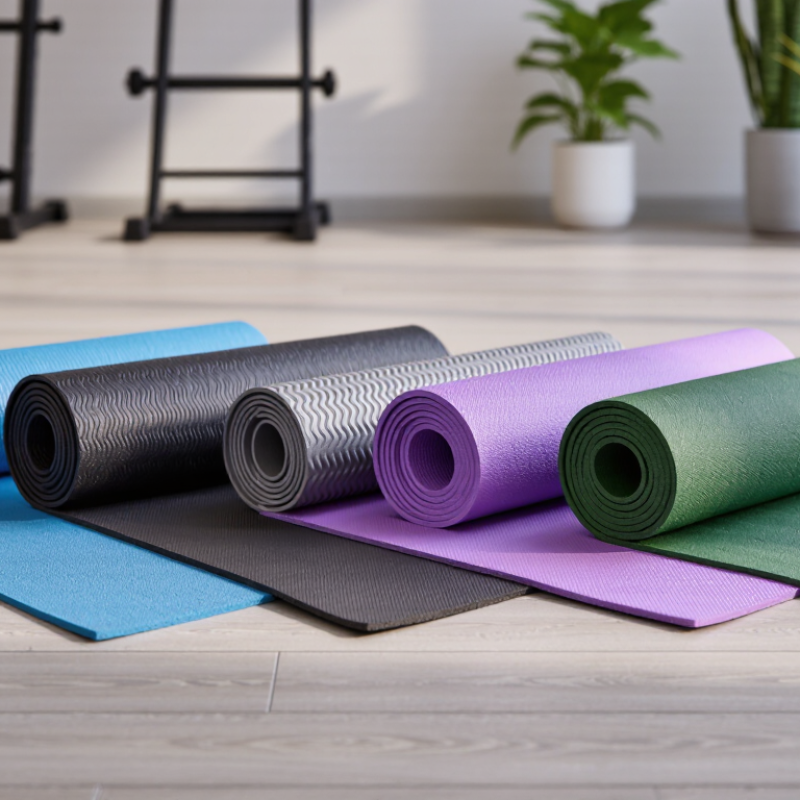
EVA means ethylene-vinyl acetate, a flexible foam used in yoga mats for cushioning and grip. Its feel depends on the foam’s density, thickness, cell structure, and surface texture, not the material name alone. A mat may feel springy under the heel yet compress too much beneath the knee. Small details matter.
For buyers comparing samples, request measured density and compression-set results. ISO 845:2006 specifies how to determine apparent density in cellular plastics, while ISO 1856:2018 covers compression-set testing. These figures help compare foam consistency and its ability to recover after pressure; they do not, by themselves, predict comfort or traction. Ask suppliers to test samples from the same production specification. Then try poses on a hard floor, especially lunges and kneeling positions.
Look closely at the cut edge. Even cells and consistent thickness can indicate more uniform foam, though appearance is not proof of durability. I would not trust one lab number. EVA can feel light and comfortable, but a soft sample may bottom out during practice. Also check whether the surface becomes slick with damp hands; grip depends on finish and use, not just foam chemistry.
| Buying tip | EVA foam or design factor | What to evaluate | Practical buyer action |
|---|---|---|---|
| 1. Confirm the material composition | EVA is a copolymer of ethylene and vinyl acetate. Its properties depend on formulation and manufacturing, so “EVA” alone does not specify performance. | Ask whether the mat is EVA throughout or combines EVA with other materials, coatings, or surface layers. | Request a material declaration and product specification for the exact model being quoted. |
| 2. Match thickness to the intended practice | Thickness affects cushioning, stability, and portability. Many general-purpose yoga mats are around 3–6 mm, while thicker options provide more padding but can feel less stable in balance poses. | Check measured thickness and consistency across the mat, not just the nominal specification. | Choose a target thickness based on the intended user and practice, then verify samples with a measurement method agreed in advance. |
| 3. Test cushioning and recovery | EVA foam can provide lightweight cushioning, but firmness and compression recovery vary with foam formulation and construction. | Look for excessive denting, uneven support, or slow recovery after repeated pressure. | Compare samples under the same pressure and recovery conditions; agree on an inspection standard for production. |
| 4. Evaluate grip in realistic conditions | Grip depends on surface texture, formulation, floor contact, and moisture. A textured surface may improve traction, but performance should be checked rather than assumed. | Assess both hand-to-mat and mat-to-floor slip during dry use and, if relevant, with light perspiration. | Test the mat on common flooring types and include grip expectations in the product brief. |
| 5. Select dimensions for your target market | A commonly used mat size is approximately 173 × 61 cm, but taller users or broader practice needs may call for longer or wider formats. | Check usable length and width, edge straightness, and any dimensional tolerance in the specification. | Specify dimensions in centimetres and inches where useful, and confirm the allowed tolerance before ordering. |
| 6. Check weight, rollability, and storage | EVA mats are often selected for their lightweight construction. Thickness, density, dimensions, and added layers all affect packed weight and roll size. | Review the finished mat’s weight, rolled diameter, and whether it lies flat after unrolling. | Request packed measurements and test rollability using the intended packaging and storage method. |
| 7. Review care, odor, and compliance requirements | Cleaning guidance and odor levels can vary by materials and manufacturing. Environmental or chemical-compliance claims should be supported by relevant documentation. | Check care instructions, odor after unpacking, packaging details, and test reports required for the destination market. | Confirm applicable local requirements with an importer or qualified compliance professional; do not rely on an unsupported “eco-friendly” claim. |